Where can I take brush and yard waste for disposal?
How to Get Rid of Brush and Yard Waste in Nashville: Drop-Offs, Schedules, and Hidden Rules. Drop off locations for yard waste.
Nashville Yard Waste Disposal Quick Guide
- Free Curbside Pickup: Metro Public Works collects residential brush four times a year on a rotating seasonal schedule. Check your exact neighborhood dates using the Metro Nashville Waste Wizard tool.
- Free Drop-Off Sites: Davidson County residents can drop off yard waste for free at two Living Earth facilities:
- East Nashville: 1511 Elm Hill Pike
- West Nashville: 6401 Centennial Blvd
- Requirement: Bring a valid ID or Nashville utility bill to prove county residency.
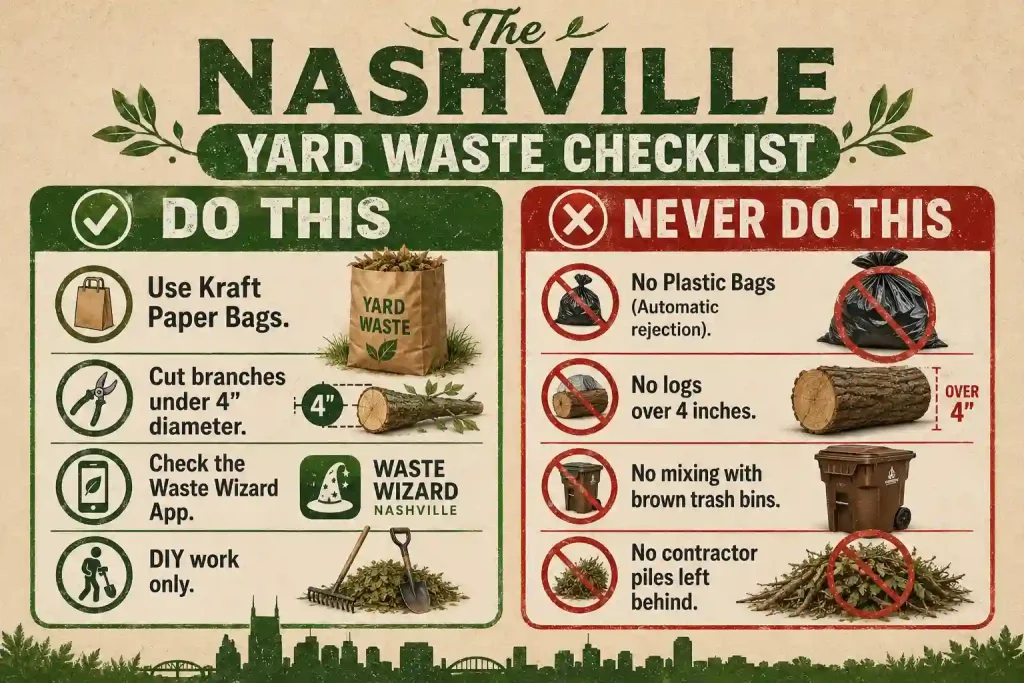
- Plastic Bag Ban: Grass clippings and leaves must be placed in biodegradable paper bags or loose in reusable containers. Plastic bags will not be collected or accepted.
- Size Restrictions: Curbside branches must be under 4 inches in diameter and under 15 feet in length. Stacks must be placed away from low-hanging wires, mailboxes, and water meters.
- The Contractor Exception: By law, if you hire a commercial landscaper or tree trimmer, the city will not collect the debris. The hired contractor is legally responsible for hauling it away.
The Nashville Yard Waste Dilemma
Nashville Yard Waste Disposal: Curbside vs. Drop-Off
Feature | Option 1: Metro Curbside Pickup | Option 2: Living Earth Drop-Off Sites |
Cost | 100% Free for residents | 100% Free (with valid Davidson Co. ID) |
Frequency | 4 times a year (rotating seasonal schedule) | Available year-round (Monday–Saturday) |
Best For | Routine yard maintenance & predictable seasonal cleanups | Large volume debris, immediate cleanup, or storm damage |
Bag Rules | Strictly biodegradable paper bags only; no plastic | Loose debris or paper bags; no plastic bags allowed |
Size Limits | Branches must be under 4″ diameter & 15′ length | Accepts larger logs and stumps (fees may apply for commercial sizes) |
Effort | Low (just stack properly at your property line) | Medium (requires a truck, trailer, and manual unloading) |
How Should You Dispose of Your Nashville Yard Waste?
How much yard waste are you dealing with?
- Just a few bags of grass or leaves: Skip to Section 4 (Curbside Collection). You can easily set these at your curb during your neighborhood’s next designated pickup cycle.
- A massive truckload of heavy branches and debris: Skip to Section 5 (Drop-Off Centers). Waiting for curbside pickup with a massive pile can kill your grass and violate local codes.
How fast do you need Yard Waste gone?
- I need it gone right now: Skip to Section 5 (Drop-Off Centers). If you have a truck or trailer, you can haul it to a local facility today.
- I can wait a few weeks or months: Skip to Section 4 (Curbside Collection). If the debris is neatly stacked and safely out of the way, you can just wait for your scheduled city collection.
Did you pay someone to cut down the trees or clear the brush?
- Yes, I hired a professional contractor: Stop right here and read Section 6 (The Contractor Trap). This is a critical legal rule that catches many Nashville homeowners off guard and leaves them with unpickupable trash piles.
- No, I did all the heavy lifting myself: You qualify for all free city services. Proceed to Section 4 or 5 based on your timeline.
The Golden Rules of Nashville Yard Waste Preparation
The Zero-Plastic Policy
Metro Nashville enforces a strict ban on plastic bags for any vegetative debris. Because this material is hauled directly to regional composting systems, plastic creates severe structural contamination.
- Approved Bagging: All leaves, grass clippings, and small trimmings must be packed exclusively in biodegradable paper kraft bags.
- The Container Alternative: You may also place loose yard waste into clearly marked, personal reusable plastic or metal bins. The collection crews will empty the contents into the truck and leave your bin behind.
Precise Dimension Restrictions for Brush
Branches, limbs, and brush piles are picked up by specialized “knuckle-boom” trucks equipped with mechanical claws. If your wood debris is too thick or too long, the machinery cannot safely lift or process it.
- Maximum Diameter: Individual tree limbs and branches must not exceed 4 inches in diameter.
- Maximum Length: Individual branches must be cut down to a maximum of 12 feet in length.
- Stump Exceptions: Tree stumps are accepted but are limited to a maximum of 8 inches in diameter and must be completely free of root balls and excess dirt.
- Bamboo Restrictions: If you are clearing invasive bamboo, stalks must be cut under 8 feet long.
Method 1: Metro Nashville Curbside Brush Pickup
Every residential property within the Urban Services District (USD) and participating General Services District (GSD) neighborhoods qualifies for free curbside brush collection.
The 4-Times-a-Year Schedule
Metro Public Works splits Davidson County into distinct operational zones, executing massive county-wide sweeps four times per year on a rotating seasonal cycle. Because crews only pass by each street once per designated cycle, timing your pile placement is critical.
Tracking Your Dates: Do not guess your pickup window. Residents should utilize the official Metro Nashville Waste Wizard Tool online. By typing in your specific home address, the portal populates the exact calendar start date for your neighborhood’s next collection window.
Strategic Pile Placement Guidelines
Where and how you stack your brush determines whether the mechanical claw can lift it. Because only a single operator drives the knuckle-boom truck without an auxiliary ground crew, your pile must be fully accessible from the roadway.
The Buffer Zone: Stack your brush piles end-to-end directly along your property line or curb.
Obstruction Warning: Never stack brush against mailboxes, fences, utility poles, trees, or directly beneath low-hanging overhead power lines. The mechanical boom requires clear overhead space to operate safely.
Prohibited Zones: Do not sweep leaves or stack branches into street gutters, ditches, sidewalks, or bike lanes. Blocking these corridors violates Metro Code Title 15 and risks clogging storm drainage networks.
Method 2: Free Drop-Off Sites via Living Earth Partnership
If you miss your neighborhood’s curbside collection window or simply cannot wait months for the next scheduled cycle, Davidson County residents can bypass the timeline entirely. Through an active municipal partnership with Living Earth, local homeowners can self-haul their residential yard waste directly to processing centers completely free of charge.
The Two Primary Mega-Facilities
- East/Central Nashville Location: 1511 Elm Hill Pike, Nashville, TN 37210
- West Nashville Location: 6401 Centennial Blvd, Nashville, TN 37209 (situated near West Nashville Wrecker Service)
Standard Operating Hours & Verification Checklist
- Required Documentation: You must present a valid Tennessee Driver’s License confirming a Davidson County address, or a current Metro Nashville utility bill matching your ID.
- Vehicle Limits: Free disposal is strictly allocated to residential pickup trucks (up to standard bed sizes) and passenger vehicles. If you haul your debris using a hitched pull-behind utility trailer, Living Earth will apply a commercial tipping fee based on the volume or weight.
- Hours of Operation: Standard facilities operate Monday through Friday from 7:00 AM to 5:00 PM, and Saturdays from 8:00 AM to 2:00 PM. (Note: Hours can fluctuate seasonally or scale up to extended emergency timelines following major regional storm events).
The "Contractor Trap" (The Hidden Law Every Nashville Homeowner Must Know)
Imagine this Scenario:
You hire a professional tree service or landscaping company to trim your large oak trees or clear out thick brush lines on your property. The crew does an incredible job, cuts everything down beautifully, stacks a massive pile of branches neatly by your curb, and tells you, "Don't worry, Metro Nashville's claw truck will pick this up for free on their next run." They cash your check, drive away, and weeks later, your brush pile is still sitting there. Your grass is dead underneath it, you receive an official orange warning tag from Metro Code Enforcement, and you face a hefty fine. What went wrong? You just fell right into The Contractor Trap.
The Legal Reality of Commercial Debris in Davidson County
How to Protect Yourself from Shady Landscapers
- Read the Fine Print: Before signing any contract, ensure there is an explicit line item that reads: “Includes full haul-away and disposal of all tree and brush debris.”
- Reject the “City Will Get It” Excuse: If a contractor tells you the city will pick it up, they are either misinformed or intentionally avoiding Living Earth’s commercial tipping fees.
- Demand a Disposal Receipt: For large-scale projects, you can ask your contractor for a copy of their disposal receipt from a commercial recycling center to ensure the material was legally dumped.
- The DIY Exception: Remember, the city will only pick up the pile if you were the one who physically cut it, trimmed it, and carried it to the curb yourself.
Emergency Situations & Storm Cleanup
How Emergency Rules Shift After a Storm
- Suspension of Sizing Restrictions: During emergency sweeps, the standard rules limiting branches to 4 inches in diameter or 12 feet in length are suspended. NDOT emergency crews will collect massive logs, shattered canopies, and fallen trunks directly from the curb.
- The Clearance Mandate: The only strict rule remaining during a storm cleanup is that your debris pile must not block vital infrastructure. Piles must be kept completely clear of sidewalks, bike lanes, vehicle travel lanes, fire hydrants, and storm water catch basins. Keeping infrastructure clear prevents localized flooding and allows emergency vehicles to pass safely.
- FEMA Tracking Requirements: Emergency collections are carefully logged and weighed by embedded city monitors to qualify Nashville for federal FEMA disaster reimbursement funds.
The Strict Backyard Burning Ban
What if I need a Private Hauler?
What If You Can’t Wait? Private Junk Removal services in Nashville is a good option. If you have missed Metro’s quarterly curbside pickup window and do not own a truck or a utility trailer to haul debris to Living Earth, your best option is to hire a private junk removal or local hauling service.
Pro-Tip: How to Lower Your Private Hauling Bill
Private haulers prioritize speed and ease of loading. If you want to keep your costs at the lowest end of the pricing spectrum, make sure you prepare the pile efficiently before they arrive: Consolidate Your Pile: Drag all branches and bags to a single, easily accessible location right next to your driveway. If the crew has to walk to your backyard or haul limbs up a steep hill, they will add labor surcharges to your final invoice. Pre-Cut Heavy Wood: Use a chainsaw to break long limbs into shorter, stackable segments. Compact piles take up significantly less volume inside the junk truck, saving you money on the overall tier pricing.
Frequently Asked Questions (FAQ)
Can I put yard waste or grass clippings in my standard brown rolling trash bin?
What should I do if the city claw truck misses my house during a scheduled pickup cycle?
Does Metro Nashville accept yard waste packed in clear plastic bags?
No. Metro collection crews and Living Earth processing centers enforce a zero-tolerance policy against all forms of plastic packaging, including clear, black, or branded plastic lawn bags. All soft debris must be packed exclusively in biodegradable paper kraft bags or placed completely loose inside reusable garbage bins.
Can residents get free mulch back from the city?
Yes. All brush collected by NDOT claw trucks is processed and transported to Living Earth facilities, where it is ground and recycled into industrial mulch. Davidson County residents can visit Living Earth locations to purchase this organic mulch at highly discounted rates, or take advantage of periodic free mulch give-back events hosted by Metro Public Works.
Are private streets serviced during municipal brush collections?
No. Metro Nashville’s curbside brush collection machinery only services properties located along publicly maintained city roadways. If you reside on a private street, within a gated community, or inside certain townhome developments with private alley networks, you must self-haul your debris to a drop-off center or coordinate a private junk haul-away service.